Continental Steel & Tube Co.
P.O. Box 030040
Fort Lauderdale, FL 33303-0040
Phone: 954-332-2290
Fax: 954-332-2296
Toll-free: 877-761-3491
Email: sales@continentalsteel.com
Website: http://www.continentalsteel.com
All Categories > Aluminum > Aluminum Rounds > Aluminum Rounds - Series 2011-T3 > Item # 2011-T3-813  


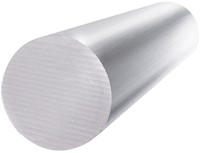
Item # 2011-T3-813, Aluminum Rounds - Series 2011-T3


2011 is the most free-machining of the common aluminum alloys. It also has excellent mechanical properties. Thus, it is widely used for automatic screw machine products in parts requiring extensive machining.

2011-T3
AMS-QQ-A-225/3 ASTM B211 UNS A92011


Specifications  · Typical Mechanical Properties  · Comparative Characteristics and Applications  · Aluminum Alloy Designations

Specifications

Material

Aluminum

Shapeform

Round

Series

2011-T3

Grade

2011

Temper

T3

Diameter

13/16 inches

Diameter

0.813 inches

Estimated Weight

0.6350 lbs/ft

Estimated Weight per 12' Bar

7.616 lbs

ASTM Specification

AMS-QQ-A-225/3
ASTM B211

UNS A92011

Ultimate Strength

55 ksi

Yield Strength

43 ksi

Density

0.102 lbs/in³

Specific Gravity

2.83


Typical Mechanical Properties

Elongation percent in 2 inches

15

Hardness Brinnel Number

View
95

Ultimate Shearing Strength

32 ksi

Fatigue Endurance Limit1

18 ksi

Modulus of Elasticity2

10.2 x 10² ksi
1 Based on 500,000.000 cycles of completely reversed stress using the R. R. Moore-type of machine and specimen.
2 Average of tension and compression moduli. Compression modulus is about 2 percent greater than tension modulus.


Comparative Characteristics and Applications

Resistance to Corrosion - General1

D

Stress Corrosion Cracking2

D

Workability (Cold)3

C

Mechinability

A

Brazeability4

D

Gas Weldability5

D

Arc Weldability6

D

Resistance Spot and Seam Weldability7

D

Applications

Screw machine products
1 Ratings A through E are relative ratings in decreasing order of merit, based on exposures to sodium chloride solution by intermittent spraying or immersion. Alloys with A and B ratings can be used in industrial and seacoast atmospheres without protection. Alloys with C, D and E ratings generally should be protected at least on faying surfaces.
2 Stress-corrosion cracking ratings are based on service experience and on laboratory tests of specimens exposed to the 3.5% sodium chloride alternate immersion test.
3 Ratings A through D for Workability (cold), and A through E for Machinability, are relative ratings in decreasing order of merit.
4 Ratings A through D for Weldability and Brazeability are relative ratings.
5 A = Generally weldable by all commercial procedures and methods.
B = Weldable with special techniques or for specific applications that justify preliminary trials or testing to develop welding procedure and weld performance.
C = Limited weldability because of crack sensitivity or loss in resistance to corrosion and mechanical properties.
6 A = Generally weldable by all commercial procedures and methods.
B = Weldable with special techniques or for specific applications that justify preliminary trials or testing to develop welding procedure and weld performance.
C = Limited weldability because of crack sensitivity or loss in resistance to corrosion and mechanical properties.
7 A = Generally weldable by all commercial procedures and methods.
B = Weldable with special techniques or for specific applications that justify preliminary trials or testing to develop welding procedure and weld performance.
C = Limited weldability because of crack sensitivity or loss in resistance to corrosion and mechanical properties.


Aluminum Alloy Designations
    The aluminum industry uses a four-digit index system for the designation of its wrought aluminum alloys.
    As outlined below, the first digit indicates the alloy group according to the major alloying elements.

    1xxx Series
    In this group minimum aluminum content is 99% and there is no major alloying element. The second digit indicates modifications in impurity limits. If the second digit is zero, there is no special control on individual impurities. Digits 1 through 9, which are assigned consecutively as needed, indicate special control of one or more individual impurities. The last two digits indicate specific minimum aluminum content. Although the absolute minimum aluminum content in this group is 99%, the minimum for certain grades is higher than 99%, and the last two digits represent the hundredths of a per cent over 99. Thus, 1030 would indicate 99.30% minimum aluminum. without special control on individual impurities. The designations 1130, 1230, 1330, etc.. indicate the same purity with special control on one or more impurities. Likewise 1100 indicates minimum aluminum content of 99.00% with individual impurity control.

    2xxx through 9xxx Series
    The major alloying elements are indicated by the first digit, as follows:
      2xxx Copper
      3xxx Manganese
      4xxx Silicon
      5xxx Magnesium
      6xxx Magnesium and silicon
      7xxx Zinc
      8xxx Other element
      9xxx Unused series

    The second digit indicates alloy modification. If the second digit is zero. it indicates the original alloy: digits 1 through 9, which are assigned consecutively, indicate alloy modifications. The last two digits have no special significance, serving only to identify the different alloys in the group.

    Experimental Alloys
    Experimental alloys are designated according to the four digit system, but they are prefixed by the letter X. The prefix is dropped when the alloy becomes standard. During development, and before they are designated as experimental, new alloys are identified by serial numbers assigned by their originators. Use of the serial number is discontinued when the X number is assigned.


Print Back